Odometer Fraud: How to Spot a Mileage Rollback and Protect Yourself
What you will learn in this guide:
- How odometer fraud works on both analog and digital instruments, and why digital is not tamper-proof
- A repeatable "Mileage Timeline Forensics" method to cross-check records, wear, and data before buying
- How to read and interpret mileage discrepancies in a vehicle history report without overreacting
- What federal odometer disclosure rules require, including exemption thresholds
- What to do if you suspect a rollback, including reporting options and when to walk away
Mileage is the single number buyers often trust most when pricing a used car. A difference of tens of thousands of miles on an older car can materially affect the asking price, depending on market and condition. That pricing leverage is one reason odometer fraud persists.
NHTSA defines odometer fraud as "the disconnection, resetting or alteration of a vehicle's odometer with the intent to change the number of miles indicated" (accessed 2026-02-11) and estimates that more than 450,000 vehicles are sold each year with false odometer readings. The exact number is difficult to measure, but the risk is not limited to any one sales channel. It can show up in private sales, at auctions, and across online marketplaces.
This guide teaches you a repeatable cross-check process so you can verify mileage yourself, no matter how clean a listing looks on the surface.
Quick Sign Checklist: Is the Mileage Real?
Before diving into the full forensic process, here is a fast reference list of the highest-signal indicators that an odometer reading may not reflect the car's true mileage.
Timeline red flags (data):
- Mileage has decreased between any two recorded events (title transfers, inspections, services)
- A gap of more than 18 months with no recorded mileage event
- Claimed annual mileage is extremely low for the car's age, with no documentation explaining why
- Title carries a "Not Actual Mileage" or "Exceeds Mechanical Limits" brand
Physical red flags (wear):
- Brake and gas pedals show heavy rubber wear inconsistent with low stated mileage
- Steering wheel grip area is shiny, smooth, or worn through
- Seat bolsters (the side edges of the driver seat) are collapsed or fabric is pilling
- Dashboard screws show signs of removal (scratched heads, mismatched screw types)
- Maintenance stickers (oil change, timing belt) reference a higher mileage than the odometer currently shows
How Odometer Fraud Happens Today
Digital Odometers Are Not Tamper-Proof
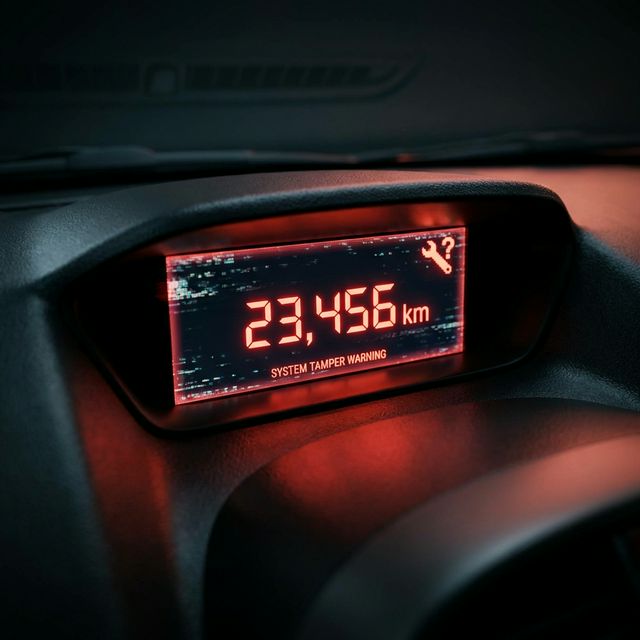
The transition from mechanical to digital odometers did not solve the problem. It changed the tools. Analog odometers were rolled back with drills and careful manipulation of physical gears. Digital odometers can be altered using specialized tools and software that change the stored mileage value in the instrument cluster.
The same kinds of tools can also have legitimate uses, such as calibrating a replacement cluster after a repair. Using any method to intentionally misrepresent a vehicle's mileage can violate federal law (see 49 U.S.C. 32703, accessed 2026-02-11).
The core reality to understand: a digital display showing 62,000 miles does not prove the car has driven 62,000 miles. It proves the instrument cluster is currently programmed to display that number.
Instrument Cluster Swaps
A more sophisticated method involves replacing the entire instrument cluster with one showing lower mileage. This can be done using a cluster from a salvage vehicle of the same make and model. After the swap, the dashboard display shows the donor cluster's mileage, not the car's actual mileage.
In some vehicles, mileage data may be stored in more than one electronic location, and a thorough diagnostic scan can sometimes reveal inconsistencies. This varies by make, model, and tool.
Why Legitimate Repairs Can Create Confusing Data
Not every mileage discrepancy is fraud. A cluster replacement under warranty, a battery disconnect that temporarily corrupted a stored value, or a data entry error at a service shop can all create records that look suspicious but have innocent explanations.
The difference between fraud and a legitimate anomaly is usually visible in the surrounding context:
- Fraud pattern: Mileage drops between consecutive title events, and physical wear is inconsistent with stated mileage.
- Repair pattern: A single data point is lower than expected, but the points before and after it continue a consistent upward trend, and the seller can provide documentation of the repair.
The "Mileage Timeline Forensics" Method
The most reliable way to verify an odometer reading is not any single check. It is a cross-reference process that compares multiple independent data sources against each other and against the car's physical condition. Think of each data source as a witness. One witness can be wrong. Multiple independent signals pointing the same way is stronger evidence.
Reconstruct the Mileage Timeline from Records
Gather every available mileage data point and arrange them chronologically. Each source type captures mileage at a different moment in the car's life:
| Record Type | What It Records | Where to Find It |
|---|---|---|
| Title transfers | Odometer reading at each ownership change | Vehicle history report, state DMV records |
| Emissions and safety inspections | Odometer at each test date | State inspection databases, history report |
| Service and maintenance records | Odometer at each visit | Dealer service records, independent shop receipts, owner's records |
| Auction records | Odometer at time of sale | Auction history in vehicle history report |
| Oil change and maintenance stickers | Mileage at last service | Typically on the windshield, door jamb, or under the hood |
Start with a VinReport history check to pull the compiled mileage timeline. NHTSA advises buyers to "request a vehicle history report to check for odometer discrepancies in the vehicle's history" (accessed 2026-02-11), and a good report may compile readings from sources like NMVTIS, insurance records, auction data, and service histories into a single timeline when those data are available.
Apply the Logic Check: Does the Annual Mileage Make Sense?
Once you have a timeline, calculate the implied annual mileage between data points. As a rough rule of thumb, many drivers land somewhere in the thousands to low tens of thousands of miles per year, but it varies widely by location and use.
Significant deviations deserve questions, not immediate conclusions. For example:
- A very low annual mileage on a daily-commuter type vehicle: Possible, but you should ask why. Was it a second car? A seasonal vehicle? In storage?
- A higher annual mileage on a commuter or work vehicle: Often plausible and does not automatically indicate a problem.
- A consistently very low annual mileage for many years: Unusual without strong supporting documentation.
The point is not that any specific number is "right." The point is that the pattern should be internally consistent and explainable by the car's use case.
Spot the 'Impossible' Drop: When Numbers Go Backward
A mileage reading that is lower than a previous recorded reading is the strongest data signal of tampering. Here is what a rollback pattern looks like in a timeline:
| Date | Event | Mileage |
|---|---|---|
| 2019-03-15 | State inspection | 87,200 |
| 2020-06-20 | Oil change (shop receipt) | 102,800 |
| 2021-01-10 | Title transfer | 48,500 |
| 2022-04-01 | Emissions test | 61,300 |
In this example, the mileage drops from 102,800 to 48,500 at the title transfer. The readings after the drop (61,300 at the next emissions test) are consistent with the lower number, not with the earlier records. This pattern is often consistent with a rollback: the odometer may have been changed between the oil change and the title transfer, and subsequent readings reflect the new starting point.
Cross-Check the Timeline Against Physical Wear
Numbers can be altered. Physical wear cannot be easily reversed. After building and reviewing the data timeline, inspect the car in person (or hire a mechanic to do so) and compare what you see to what the mileage claims.
This step is covered in detail in the next section.
Physical Evidence: Wear Patterns That Should Match the Number
NHTSA's detection guidance includes looking at "the wear and tear on the vehicle ... to be sure it seems consistent with and appropriate for the number of miles displayed on the odometer" (accessed 2026-02-11). Here is how to apply that in practice.
The "Touch Point" Test: Pedals, Steering Wheel, and Shifter
These are the surfaces a driver contacts on every single trip. They wear proportionally to use and are difficult to replace without visible evidence.
| Component | Low Mileage (under 60k) | Moderate (60k to 120k) | High (120k+) |
|---|---|---|---|
| Brake pedal rubber | Original texture, sharp edges on pattern | Slightly smoothed center | Pattern worn smooth or rubber worn through |
| Gas pedal rubber | Crisp pattern | Center wear visible | Bare metal or replacement pad |
| Steering wheel | Uniform texture | Grip area slightly smoother | Shiny, smooth, or leather cracking at 10 and 2 |
| Shift knob | Clean lettering, crisp edges | Lettering slightly faded | Lettering gone, material polished smooth |
These mileage ranges are only heuristics. Driving conditions, materials, footwear, and prior repairs can change wear patterns.
A car claiming 55,000 miles with worn-through pedal rubber and a polished-shiny steering wheel deserves scrutiny. Those parts tell a different story than the dashboard.
Seat Bolsters and Interior Surfaces
The driver's seat side bolster (the raised edge closest to the door) takes compression and friction every time the driver enters and exits the vehicle. On a genuine low-mileage car, this surface should be firm and evenly textured. On a high-mileage car, it collapses, wrinkles, or shows fabric pilling.
Also check:
- Armrest surfaces: Leather or vinyl should match the stated age and mileage pattern.
- Floor mat wear: Original mats at 100,000+ miles show heel wear on the driver's side.
- Window and lock switches: High-mileage cars show polished or faded switch faces.
Under the Hood: Service Evidence
Look for physical traces of maintenance history:
- Oil change stickers: A sticker showing "Next service at 95,000 miles" on a car with an odometer reading of 58,000 is a direct data conflict.
- Timing belt cover marks: Many shops mark the timing belt cover or nearby surface with the mileage at replacement. If the car has a marked 100,000-mile timing belt service but the odometer reads 72,000, the numbers do not agree.
- Hose and belt condition: Cracked or brittle rubber suggests more age and heat cycles than low mileage would imply.
Suspension and Undercarriage
Higher-mileage cars more commonly develop looseness in steering components, worn bushings, and uneven tire wear. A car claiming low mileage that has significant play in the steering rack, clunking over bumps, or visibly cupped tires deserves extra scrutiny. Road conditions, alignment, and tire maintenance also matter.
Interpreting History Report Discrepancies Without Overreacting
A vehicle history report is your most efficient tool for building the mileage timeline. But not every discrepancy in a report is fraud. Here is how to read the common patterns.
Clerical Errors vs. Fraud
Service shops and inspection stations enter mileage manually. A technician typing 76,500 instead of 67,500 creates a data point that looks like a mileage jump followed by a drop. The difference between a clerical error and fraud:
- Typo pattern: One data point is out of sequence, but the points immediately before and after it maintain a consistent upward trend. The surrounding data makes the error obvious.
- Fraud pattern: Mileage drops and stays lower. All subsequent readings are consistent with the new (lower) baseline.
When you see a single out-of-sequence reading surrounded by consistent data, it is likely an entry error. When you see a drop followed by a new consistent trend at the lower level, that is the rollback signature.
What "Not Actual Mileage" Means on a Title
When a title carries a "Not Actual Mileage" brand, it means the transferor certified that the odometer reading "does not reflect the actual mileage, and should not be relied upon" (49 CFR 580.5(e)(3), accessed 2026-02-11). This can happen because:
- The odometer was replaced and the new cluster could not be set to the correct mileage.
- The odometer malfunctioned and stopped recording properly.
- The seller knew or suspected the reading was inaccurate.
A "Not Actual Mileage" brand is not automatically a deal-killer, but it removes your ability to trust the displayed number. You must rely entirely on the timeline data and physical inspection to estimate true mileage.
Exemption Rules: When "Exempt from Odometer Disclosure" Appears
Federal rules under 49 CFR 580.17 (accessed 2026-02-11) exempt certain vehicles from odometer disclosure requirements. The exemption thresholds work as follows:
- Model year 2010 and older: May be exempt under the calendar-year-based rule in 580.17(a)(3).
- Model year 2011 and newer: A 20-year exemption applies under 580.17(a)(4).
"Exempt" means the seller is not legally required to certify the mileage on the title. It does not mean the mileage is false. But it does mean you lose one layer of legal accountability. For exempt vehicles, your timeline forensics process and physical inspection are even more important.
Federal Odometer Disclosure Rules: What the Law Requires
Understanding the legal framework helps you know what documentation you might see at a sale and why mileage disclosures exist.
What Must Be Disclosed at Transfer
Federal regulation 49 CFR Part 580 (accessed 2026-02-11) exists to "provide transferees of motor vehicles with odometer information to assist them in determining a vehicle's condition and value." At every transfer of a non-exempt vehicle, the seller must provide:
- The odometer reading at the time of transfer
- The date of transfer
- The vehicle identification number (VIN)
- A certification of whether the mileage is "actual," "not actual," or "exceeds mechanical limits"
This disclosure is typically printed on the title itself or on a separate disclosure form that accompanies the title.
The Prohibition on Tampering
49 U.S.C. 32703 (accessed 2026-02-11) prohibits certain forms of odometer tampering and mileage misrepresentation. Violations can carry civil and criminal penalties under federal and state law.
Odometer tampering is prohibited under federal law, and buyers who are harmed may have legal remedies depending on the facts and their state.
What to Do If You Suspect a Rollback
Questions to Ask the Seller (Without Accusing)
If your timeline review or physical inspection raises concerns, start with open-ended questions rather than accusations:
- "Can you walk me through the maintenance history for the last few years?"
- "I noticed the mileage on the inspection record from 2021 is higher than what the odometer shows now. Do you know why that might be?"
- "Was the instrument cluster or dashboard ever replaced or repaired?"
- "Do you have the original title, or has the car been retitled?"
Listen for specifics. A seller who can point to a documented cluster replacement under warranty is telling you something verifiable. A seller who gets vague, defensive, or changes the subject is telling you something too.
What Documentation to Request
Ask for:
- All prior titles (not just the current one)
- Service records from the dealer or independent shops
- Any warranty repair documentation, especially cluster or module replacements
- Emissions and inspection records (some states make these available online by VIN)
Cross-reference every document against your mileage timeline. Each piece of paper that confirms the timeline adds confidence. Each piece that contradicts it adds concern.
When to Pay for a Pre-Purchase Inspection
If the data is ambiguous (timeline is mostly clean but one or two points are unclear, and the seller has a partial explanation), a pre-purchase inspection by an independent mechanic can help resolve the question. A good mechanic can:
- Run a diagnostic scan that may reveal inconsistencies across vehicle systems (this varies by make, model, and tool)
- Evaluate physical wear against the stated mileage
- Identify signs of cluster removal or dashboard disassembly
The FTC is explicit (accessed 2026-02-11): "A vehicle history report is not a substitute for an independent vehicle inspection." When mileage is in question, the inspection becomes even more essential.
The U.S. Department of Justice also recommends (accessed 2026-02-11) that consumers "obtain an independent vehicle inspection, get an NMVTIS Vehicle History Report ... and consult other available vehicle information resources" before purchasing.
How to Report Suspected Odometer Fraud
If you believe you have encountered odometer fraud, reporting it helps protect other buyers:
- NHTSA: Follow the reporting guidance on NHTSA's odometer fraud page (accessed 2026-02-11).
- State enforcement: NHTSA maintains a list of state enforcement agencies (accessed 2026-02-11) that handle individual odometer fraud cases. Your state attorney general's consumer protection division is often the right contact.
- Local law enforcement: In cases where you have purchased a vehicle and can demonstrate the odometer was altered, a police report can support a civil or criminal case.
When to Walk Away
Consider walking away from a listing if:
- The mileage timeline shows an unexplained drop between two verified events
- Physical wear clearly contradicts the claimed mileage and the seller cannot explain why
- The seller refuses to allow a pre-purchase inspection
- The seller cannot produce maintenance records for a higher-mileage vehicle
- The deal only makes sense if you fully trust the stated mileage
No car is a good deal if the mileage is misrepresented. Deferred maintenance, repair risk, and reduced resale value can quickly outweigh any apparent savings.
Protecting Yourself: The Verification Workflow
Here is the complete mileage verification process in summary. Use this on every car you consider, whether it is a private sale, a dealer lot, or an online listing.
Run a VinReport History Check
Pull the vehicle's compiled history using the VIN. Look for: mileage readings at every title transfer, inspection, and service event; title brands ("Not Actual Mileage," "Exceeds Mechanical Limits," "Salvage"); and ownership count.
Build and Review the Mileage Timeline
Arrange all mileage data points chronologically. Check for drops, gaps longer than 18 months, and implied annual mileage that does not match the car's apparent use case.
Inspect Physical Wear Against the Number
Compare pedal wear, steering wheel condition, seat bolsters, interior surfaces, and under-hood service marks to the claimed mileage. Multiple mismatches between wear and the displayed number warrant serious questions.
Get an Independent Pre-Purchase Inspection
A mechanic can run diagnostic scans that may reveal inconsistencies, check for signs of cluster removal, and evaluate whether physical condition matches the stated mileage.
Decide Next Steps
If the timeline is clean, wear matches the mileage, and the inspection confirms no concerns, you may choose to proceed. If the data conflicts and the seller cannot explain the discrepancies with documented evidence, consider walking away. There are always more cars.
Frequently Asked Questions
Can a digital odometer be rolled back?
Yes. Digital odometers store mileage as a programmed value in the instrument cluster's memory. Some tools designed for legitimate calibration purposes can also be misused to alter the stored value. Cluster swaps, where the entire instrument panel is replaced with one from a lower-mileage vehicle, are another method.
Neither method is detectable from the dashboard display alone. Detection requires cross-referencing the displayed reading against title records, service history, and physical wear patterns.
Does a vehicle history report always catch a rollback?
No. A vehicle history report compiles mileage data from titles, inspections, service records, and auction events. If the rollback happened between recorded data points and no subsequent event captured a mileage reading that conflicts with the altered number, the report may not show a discrepancy.
NMVTIS tracks odometer readings as one of five key indicators (accessed 2026-02-11), but no system captures every mile driven. The report is a strong starting point, but it works best when combined with a physical inspection and document review.
What mileage is suspiciously low for a used car?
There is no single threshold, but context matters. A much-lower-than-typical mileage for the vehicle's age can be legitimate (for example, a second car, seasonal use, or long periods in storage), but it should come with strong supporting evidence. The lower the claimed mileage relative to age, the more documentation and cross-checking you should require.
Can an odometer discrepancy be a data entry mistake?
Yes. Service shops and inspection stations enter mileage manually, and transposition errors happen (typing 76,500 instead of 67,500, for example). The difference between a typo and fraud is in the surrounding data. A single out-of-sequence reading surrounded by a consistent upward trend is likely an error. A reading that drops and stays at the lower level, with all subsequent data consistent with the new (lower) baseline, is the classic rollback pattern.
Is odometer fraud a federal crime?
Odometer tampering and mileage misrepresentation are prohibited under federal law (see 49 U.S.C. 32703, accessed 2026-02-11). Penalties and remedies depend on the specific facts and may also involve state law. For reporting pathways, NHTSA maintains a directory of state enforcement agencies (accessed 2026-02-11).
What does "Exempt from Odometer Disclosure" mean on a title?
Under 49 CFR 580.17 (accessed 2026-02-11), vehicles that meet certain age thresholds are exempt from the federal requirement that the seller certify the odometer reading at transfer. For model year 2010 and older, the calendar-year-based exemption in 580.17(a)(3) applies. For 2011 and newer, a 20-year rule applies under 580.17(a)(4).
"Exempt" does not mean the mileage is wrong. It means the seller had no legal obligation to certify it, so you cannot rely on the title's mileage field. Build your timeline from other sources and inspect the car thoroughly.
Final Thought: The Number Is Just a Claim Until You Verify It
Every odometer reading is an assertion, not a fact, until it is supported by a consistent trail of evidence. The mileage timeline forensics method in this guide gives you a repeatable process to test that assertion: pull the history, check the records, inspect the wear, and get an independent opinion.
Start with a VinReport history check to build the timeline. Then verify it in person. The process takes time, but it can help you avoid expensive surprises.
For more on evaluating used cars, see our guides on checking VIN accident history, detecting flood damage, and finding reliable used cars under $10,000.
This article is for informational purposes only and does not provide legal or financial advice. VinReport compiles data from multiple sources including NMVTIS, insurance records, auction histories, and service records. No vehicle history report can guarantee completeness. Always combine a VIN check with an in-person inspection and, when in doubt, a professional pre-purchase evaluation. External sources were accessed on 2026-02-11.